
Basement Flooring Options: What Works Best Below Grade?
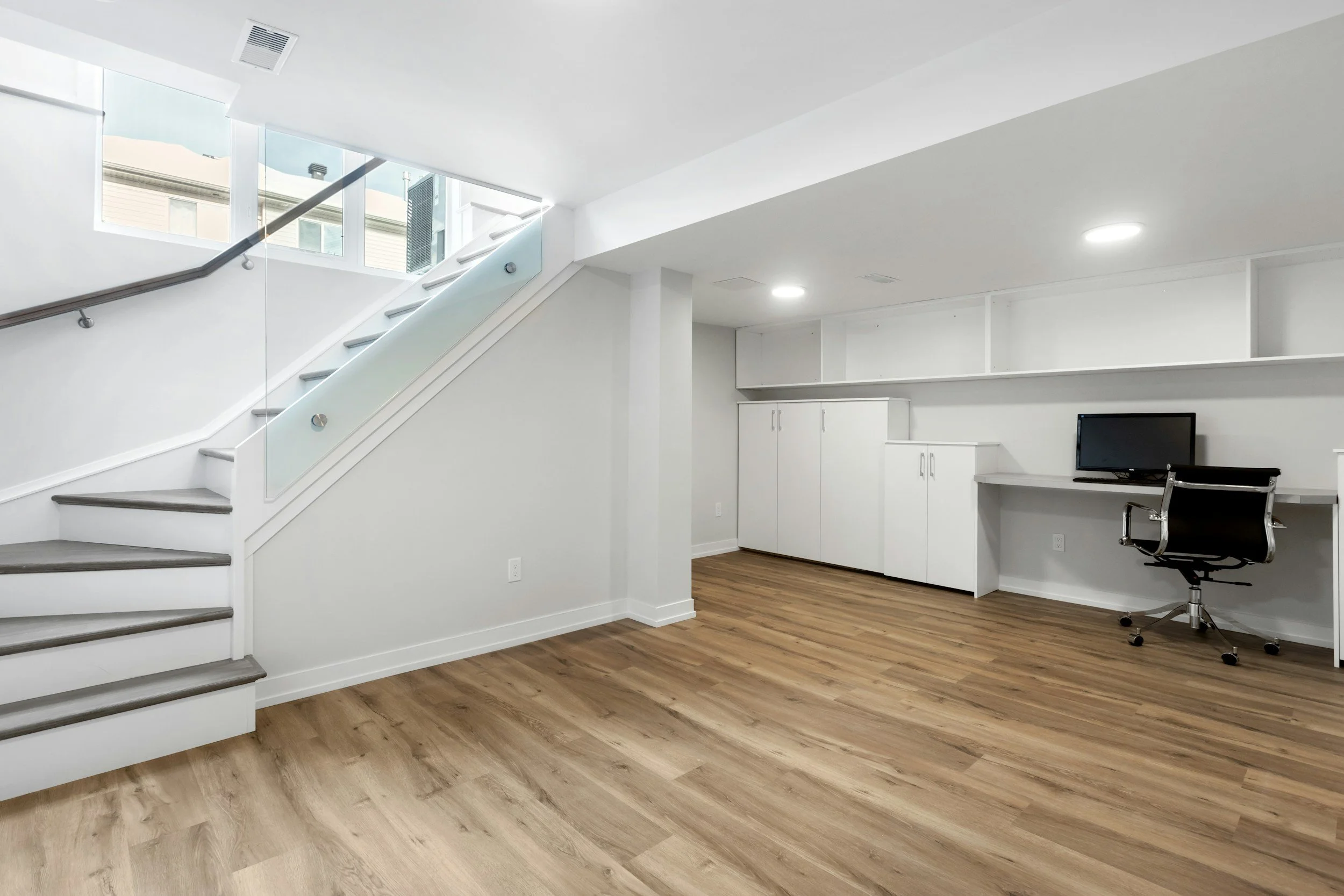
The best basement flooring can tolerate moisture, remain stable over concrete, and be cleaned or removed if water enters the space. Porcelain or ceramic tile, luxury vinyl, and properly finished concrete are usually the most practical choices. Engineered wood, laminate, and carpet can work in some basements, but they require more careful moisture control and product selection.
Below-grade floors face conditions that may not occur elsewhere in the home. Water vapor can move through a concrete slab even when the surface appears dry, and condensation can form when humid air reaches cool concrete. Plumbing leaks, foundation seepage, and flooding add further risk.
Correct moisture problems before installing any finished floor. A water-resistant material does not repair a wet basement.
Inspect and Test the Concrete First
Look for water stains, efflorescence, peeling coatings, musty odors, cracks, and visible mold. Check the basement after heavy rain rather than relying only on its condition during dry weather. Repair plumbing leaks and determine whether gutters, grading, drains, or foundation defects are directing water into the building.
The moisture condition of the slab should be evaluated using the method required by the flooring manufacturer. Professional installers may use relative-humidity testing within the concrete or moisture-vapor emission testing. A simple sheet of plastic taped to the floor can reveal obvious condensation, but it is not a substitute for the testing required by a product warranty.
Building Science Corporation notes that a basement slab can appear dry because moisture is evaporating into the room. Covering that slab may trap moisture beneath the new flooring. The flooring, adhesive, underlayment, and vapor-control system must therefore be compatible with the measured conditions.
Porcelain and Ceramic Tile
Porcelain and ceramic tile are strong choices for basements that may experience occasional moisture. The tile itself does not provide food for mold and will not swell like wood-based flooring. It is also durable, easy to clean, and suitable for laundry areas, workshops, and finished living spaces.
Tile does not make the basement waterproof. Moisture can still affect grout, adhesives, crack-isolation products, or the slab below. Cracks and movement in the concrete should be assessed before installation, and the setting materials must be approved for the location.
The main disadvantage is comfort. Tile over concrete can feel cold and hard. Area rugs can improve comfort if they are removable and the basement remains dry. A properly designed insulated subfloor or heating system may also help, but it adds height, cost, and installation complexity.
Luxury Vinyl Plank and Tile
Luxury vinyl plank and luxury vinyl tile are popular because they combine a warmer appearance with relatively simple maintenance. Many products resist damage from surface spills, and specific collections are approved for below-grade installation.
However, “waterproof” flooring does not mean the complete installation is protected from moisture below the slab. Water can still collect under floating planks, affect adhesives, support mold growth on dust or adjacent materials, and damage baseboards or wall finishes.
Confirm that the exact product is rated for below-grade use. Follow its limits for concrete moisture, flatness, underlayment, vapor retarders, expansion space, and installation temperature. Do not assume that every vinyl plank uses the same system.
Vinyl is often the most balanced option for a dry finished basement where appearance, comfort, and easy cleaning are priorities.
Finished or Coated Concrete
Existing concrete can serve as the finished floor when cost, durability, and water tolerance matter more than softness. Options include polishing, staining, or applying a coating designed for concrete floors.
A coating is only as reliable as the surface beneath it. Paint, epoxy, and similar finishes may blister, peel, or lose adhesion if moisture vapor exceeds the product’s limit. Old sealers, oil, adhesive residue, and weak concrete can also interfere with bonding.
Preparation may involve cleaning, crack repair, abrasion, and moisture testing. Some older flooring adhesives and materials may contain hazardous substances, so questionable materials should be assessed before sanding, grinding, or removal.
Finished concrete works particularly well in utility rooms, workshops, exercise areas, and basements with a history of minor water exposure. Its disadvantages are hardness, sound reflection, and a cold surface.
Engineered Wood
Engineered wood is more dimensionally stable than solid hardwood because it is constructed from multiple layers. The National Wood Flooring Association identifies it as a suitable wood-floor option for basement installations.
Suitability still depends on the individual product and the condition of the space. Choose flooring specifically approved for below-grade use and follow the required moisture-control and installation system. Even engineered wood can stain, swell, delaminate, or support mold after prolonged wetting.
Engineered wood is best reserved for a consistently dry, climate-controlled basement where the appearance of real wood justifies the additional cost and risk. Solid hardwood is generally a poor below-grade choice because changes in moisture can cause substantial movement.
Laminate Flooring
Laminate varies considerably by product. Traditional laminate contains a wood-fiber core that can swell when water reaches seams or exposed edges. Some newer products offer improved water resistance and may be approved for basements.
Check the complete installation instructions rather than relying on a water-resistant label. Confirm below-grade approval, concrete moisture limits, underlayment requirements, and warranty exclusions.
Laminate can provide an affordable wood appearance, but it is less forgiving than tile, concrete, or many vinyl products when a basement has recurring leaks or flooding.
Carpet and Carpet Tile
Carpet adds warmth, sound control, and comfort, but it carries the highest moisture risk. Water can remain hidden in the backing or pad, making the assembly difficult to dry. The Environmental Protection Agency advises against installing carpet in areas with chronic leaks or frequent condensation.
In a reliably dry basement, removable carpet tiles or area rugs may be more practical than wall-to-wall carpet. Damaged sections can be lifted or replaced, and the slab remains easier to inspect. Any carpet system should be compatible with concrete and installed according to local moisture conditions.
Carpet should not be used to conceal a cold, damp, or cracked slab. Correct the underlying problem first.
Use the Room to Make the Final Choice
The best material depends on how the basement will be used.
Tile or finished concrete is practical for laundry rooms, utility spaces, workshops, and locations with an elevated risk of water. Luxury vinyl often provides the best balance for family rooms, offices, and play areas in dry basements. Engineered wood may suit a carefully controlled finished space, while removable rugs or carpet tiles can add comfort without committing to a fully carpeted floor.
Consider ceiling height before adding an insulated subfloor, underlayment, or thick flooring. Check door clearance, stair dimensions, appliances, drains, and transitions into adjoining rooms. The completed floor must also preserve access to cleanouts, sump equipment, and other service points.
No flooring should be expected to survive an unresolved water problem. Assess the slab, correct the source of moisture, review the installation requirements, and select a material that can be cleaned or repaired realistically if the basement gets wet. That preparation matters more than the surface appearance of the product.
